
The Mollymauk

History
There is a good chance you have heard Andy sing The Mollymauk in the bar of the Ancient Mariner, the Lynmouth pub that is the spiritual home of the Shanty Crew, and come away certain it was very old. That haunting, circling tune, the talk of Cape Horn and the ghosts of drowned men — it has the weight of something handed down through generations of forecastle singers. It is not. The Mollymauk was written in 1987. Its author, Bob Watson, set out to capture the vastness of the southern oceans, and did it so well that the song has since travelled the world and been taken up by shanty singers everywhere as though it had always belonged to them.
It is worth being clear about what kind of song this is. The Mollymauk is not a working shanty. It was never hauled or heaved to at a capstan or a halyard. It belongs to the great tradition of the maritime song — a piece made to be listened to rather than laboured to, closer in spirit to the forebitter sung off-watch for pleasure. That it now sits so comfortably alongside the old working songs is a mark of how true it rings.

Stories and Superstitions
First, the bird. A mollymauk — sometimes spelled mollymawk — is not a gull and not a myth. It is a true albatross, one of the smaller members of that family, found only in the Southern Hemisphere, riding the gales of the great Southern Ocean on wings that can stretch beyond two metres. For centuries, sailors rounding the Horn watched these birds hold station off the stern for days on end, never seeming to beat a wing, mastering the very winds that threatened to drive a ship onto the rocks. That effortless command of a merciless place bred wonder, and wonder bred superstition.
The oldest and most enduring of those beliefs held that an albatross carried the soul of a dead mariner. Watson's song takes that old sailor's faith and makes a whole story of it. The mollymauk of the title is no ordinary bird but "the ghost of a sailor-man," a soul set free when its body went down, now condemned — or perhaps blessed — to ride the wind forever across the southern seas, without compass, without harbour, without home. By the last verse the singer is half in love with the idea of joining it.
So the belief that Watson's mollymauk carries — the seabird as the soul of a lost sailor — is not a distant, southern-ocean fancy. It has deep roots on this very stretch of water. And there is a happy accident in it for us: the Crew's own home port, on a Thursday evening, is the Ancient Mariner in Lynmouth. When we sing The Mollymauk there, we are singing an albatross song under Coleridge's own sign, a few miles down Channel from where he dreamt the greatest albatross of them all.
Strip away the tune and The Mollymauk is really about how sailors made sense of the sea. Faced with a bird that could live where men so easily died, they did not reach for ornithology. They reached for the souls of their own drowned shipmates, and found comfort in the thought that the sea did not simply swallow a man but set some part of him loose to fly. It is a tender belief for such a hard trade, and it says a great deal about the people who held it.
That the song is modern takes nothing from it. If anything it proves that the tradition is still alive — that a good writer, working now, can pick up an old sailor's faith and give it a voice that generations of singers will treat as their own.
A Local Connection
You do not have to sail to the Horn to meet this superstition. It was written into English poetry on our own coast.
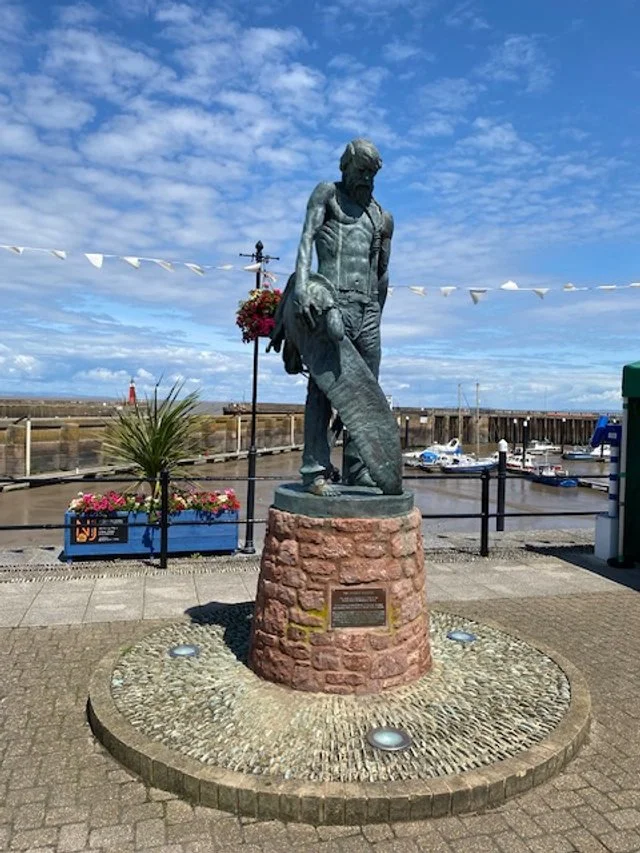
When Samuel Taylor Coleridge composed The Rime of the Ancient Mariner, the poem in which a sailor shoots an albatross and dooms his ship, he was living at Nether Stowey in the Quantock Hills, a short way along the Somerset shore of the Bristol Channel. The poem took shape on the coastal walks he made in those years, and the little harbour of Watchet, looking out across the same channel that laps the Exmoor coast, is traditionally held to be the port from which the doomed ship set sail. Watchet keeps a statue of the Mariner, albatross and all, on its quayside to this day.
Final Thoughts
Next time we sing it, listen for the wind first. The tune never quite settles; it wheels and glides the way the bird does. Then listen to who is really speaking — not a man watching a bird, but a soul that was once a man, calling back across the water to those still aboard. And if you are hearing it at the Ancient Mariner, spare a thought for the poet who put an albatross into English memory a few tides up the coast, and know that when we sing Mollymauk, we are keeping very good company indeed.

The Mollymauk
Words and music by Bob Watson, 1987
Now, the southern ocean is a lonely place
The storms are many and the shelter's scarce
Down upon the southern ocean sailing
Down below Cape Horn
Over troubled waters, under restless skies
You'll see them mollymauks rise and dive
Down upon the southern ocean sailing
Down below Cape Horn
Why don't you ride the wind and go white seabird Ride the wind and go mollymauk Down upon the southern ocean sailing Down below Cape Horn
Oh the Mollymauk glides on his great white wings
Lord, what a lonesome song he sings
Down upon the southern ocean sailing
Down below Cape Horn
He's got no compass and he's got no gear
Nobody knows where the mollymauk steers
Down upon the southern ocean sailing
Down below Cape Horn
(Chorus)
He's the ghost of a sailor so I've heard say
His body it sank and his soul flew away
Down upon the southern ocean sailing
Down below Cape Horn
He's got no haven and he's got no home
Bound evermore to wheel and roam
Down upon the southern ocean sailing
Down below Cape Horn
(Chorus)
When I gets too old and can sail no more
Set me adrift far away from shore
Down upon the southern ocean sailing
Down below Cape Horn
You can cast me loose you can set me free
I'll keep that big bird company
Down upon the southern ocean sailing
Down below Cape Horn
(Chorus)


Comments